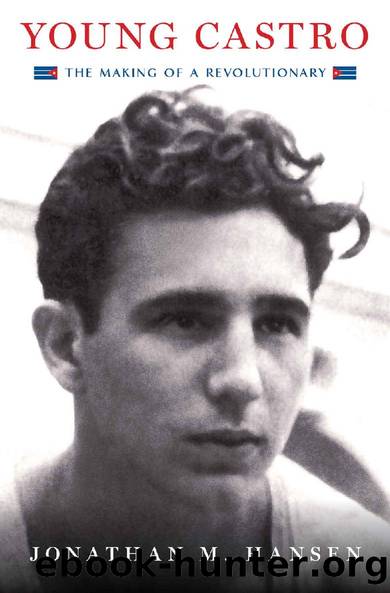
Young Castro: The Making of a Revolutionary by Jonathan M. Hansen
Author:Jonathan M. Hansen [Hansen, Jonathan M.]
Language: eng
Format: epub
Publisher: Simon & Schuster
Published: 2019-06-17T17:00:00+00:00
* * *
Hernández’s trip to Mexico went better than expected. Through Mirta, Castro learned that his lieutenant had been warmly welcomed by the exiles, all of whom were doing well. Still, her visit confirmed his suspicion that other opposition leaders were also mobilizing. In Mexico, Hernández acquired a copy of a letter from Carlos Prío instructing his agents to “penetrate the Fidelista group,” and vowing to eliminate it once coming to power, a warning Castro would never forget.12 More worrying in the short term to Castro was news that Prío had approached Aureliano Sánchez Arango, founder of the action group known as AAA, insisting that it was time for the opposition to unite. To Castro’s chagrin, Conte, Santamaría, and Hernández were inclined to agree with Prío. Two sharp letters to the two women, written in mid-June, reveal Castro’s increasingly imperious management style.
There was no evidence to suggest that Auténtico Party leaders like Prío and Sánchez Arango had a solution to the problems besetting Cuba, Castro wrote. Nor had they demonstrated any competence as opposition leaders (as evidence, he pointed to reports that a list of Auténtico members had recently been discovered by police in a suitcase loaded with contraband). In fact, the Auténtico Party appeared to be in a state of meltdown, “lacking ideals and morale and compromised to the bone.” But regardless of their current state, the women’s inclination to ally with them constituted “an ideological deviation.” If the Movement had not done so earlier when it was penniless and unknown, why would it do so now? “By virtue of what principle, what idea, what reason are we to lower our unblemished flag in their name?” he demanded. “What ideas, what history, what principles do they propose to join to ours?” Even if sincere, Prío’s overture came two years too late. The Revolution’s first order of business would be to clean out the nation’s political stables to make room for “honest men.”
The next most urgent task, Castro said, was to “mobilize tens of thousands of men.” This would not be done clandestinely, as before, but openly, with the rebels making the case for change in propaganda distributed to the Cuban people. At this critical stage of the conflict, ideological clarity and consistency was everything, and there was simply no room for those “who change their political positions like they change their clothes.” Who did this leave? Why, him and his fellow prisoners, whose self-sacrifice and discipline gave them (and them alone) the “right” to lead the Revolution. Just as the rebels had pride of place among the opposition, so he himself would lead the rebels. “I have reason to know about such things,” he told the two, “because to me has fallen the task of searching and organizing and fighting against a million intrigues.”
His lecture over, Castro turned to tactics. The biggest threat to the Movement at this time came from mercenaries ready to sell themselves to the first person able to put a gun in their hands, he said.
Download
This site does not store any files on its server. We only index and link to content provided by other sites. Please contact the content providers to delete copyright contents if any and email us, we'll remove relevant links or contents immediately.
| U.K. Prime Ministers | U.S. Presidents |
Waking Up in Heaven: A True Story of Brokenness, Heaven, and Life Again by McVea Crystal & Tresniowski Alex(37811)
Empire of the Sikhs by Patwant Singh(23086)
We're Going to Need More Wine by Gabrielle Union(19046)
Hans Sturm: A Soldier's Odyssey on the Eastern Front by Gordon Williamson(18592)
Leonardo da Vinci by Walter Isaacson(13336)
The Radium Girls by Kate Moore(12028)
Tools of Titans by Timothy Ferriss(8396)
Educated by Tara Westover(8054)
How to Be a Bawse: A Guide to Conquering Life by Lilly Singh(7486)
Permanent Record by Edward Snowden(5847)
The Last Black Unicorn by Tiffany Haddish(5636)
The Rise and Fall of Senator Joe McCarthy by James Cross Giblin(5280)
Promise Me, Dad by Joe Biden(5153)
The Wind in My Hair by Masih Alinejad(5095)
A Higher Loyalty: Truth, Lies, and Leadership by James Comey(4964)
The Crown by Robert Lacey(4817)
The Iron Duke by The Iron Duke(4356)
Joan of Arc by Mary Gordon(4112)
Stalin by Stephen Kotkin(3966)
